
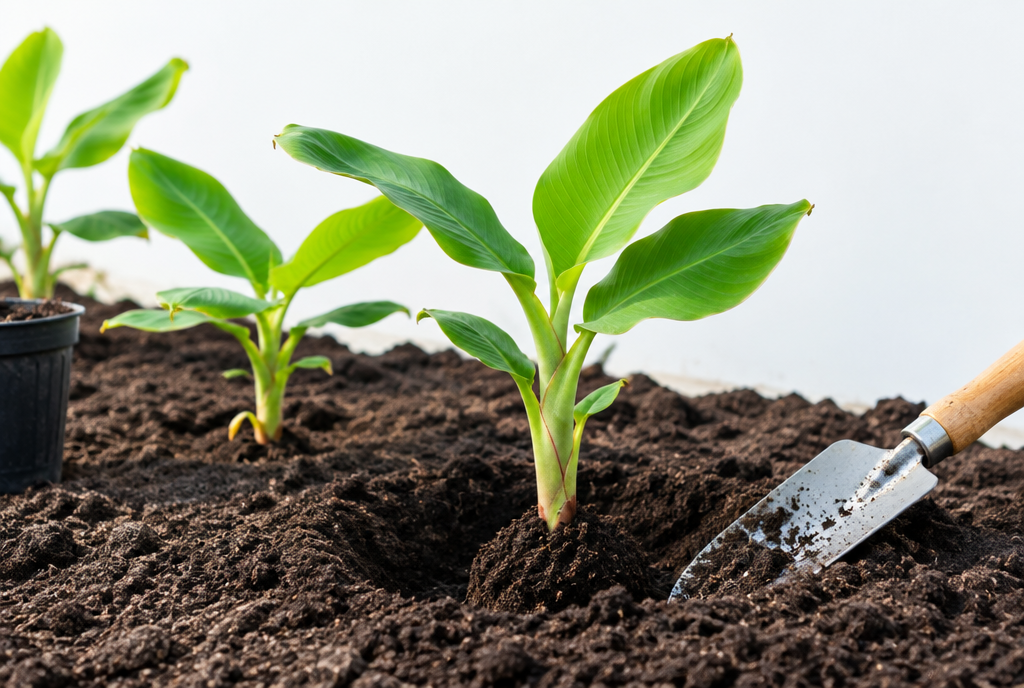
Simple steps to help your young plants take root and thrive from day one. Start with a quality sucker bag, the right growing media, and consistent care.
Give them sunshine, food and water — and eventually they’ll repay you in bananas 🍌🌱
Bananas have a wonderful habit of making an ordinary Australian backyard feel slightly tropical.
They’re fast-growing, dramatic, surprisingly productive and — once you understand what they want — not particularly difficult to grow.
But there is a difference between having a banana plant in the backyard and having a healthy banana plant that regularly produces big, worthwhile bunches.
Bananas are hungry. They’re thirsty. They don’t particularly enjoy wind. They produce children at an alarming rate. And just when you’ve finally grown a magnificent bunch, every bird and flying fox in the neighbourhood seems to receive an invitation.
So, from planting your first banana through to harvesting your first bunch, here’s how to keep your banana happy.
Start with the right spot ☀️
Before worrying about fertiliser, watering or anything else, decide where your banana is going to live.
Bananas love plenty of sunshine, so choose a position receiving good direct light. At the same time, some protection from strong winds is extremely useful.
Those enormous leaves are fantastic solar panels — but they’re also rather good sails.
A constantly wind-battered banana can end up with shredded leaves, damaged plants and, once a heavy bunch develops, an increased chance of the entire pseudostem leaning or falling.
So your ideal position is:
Sunny, warm and reasonably sheltered.
If you’re planting several bananas, around 3 metres between plants gives them plenty of access to light and room to develop.
Prepare the soil before the banana arrives
Bananas aren’t particularly interested in surviving on neglect.
They’re vigorous plants and perform best in fertile, well-drained soil containing plenty of organic matter.
Before planting, improve poor soil with compost or other well-decomposed organic material. This doesn’t just add nutrients; it helps create a healthy soil environment and improves its ability to hold moisture without becoming waterlogged.
A soil pH somewhere around 6 to 6.5 is a useful target for bananas.
Most importantly, check your drainage.
Bananas absolutely love water…
…but they hate wet feet. It’s an important distinction.
If your garden tends to hold water after heavy rain, consider building up a raised mound and planting your banana slightly above the surrounding ground level.
That allows water to move away from the root zone instead of collecting around the base.
This is particularly worth thinking about in tropical and subtropical parts of Australia where a summer downpour can deliver an impressive amount of water in a very short time.
Plant it securely
When planting an established young banana, make a generous hole and settle the root system into the prepared soil.
A banana needs to be planted firmly enough to establish a stable base as it grows. Depending on the type and size of your planting material, some growers establish it deeper than an ordinary potted garden plant.
Young tissue-cultured banana plants deserve a little extra attention.
Their root systems can initially be concentrated within the light potting medium they were raised in. For the first week or two after planting, they’re therefore considerably more vulnerable than the substantial banana plant they’ll eventually become.
Keep the surrounding soil consistently moist without saturating it while the roots begin moving into their new home.
Once those roots take off, things can change remarkably quickly.
Baby your baby banana — just for a little while
Many commercial banana plants are propagated and grown: warm, humid environments.
Move one into a hot Australian backyard with low humidity and blazing afternoon sun and those tender young leaves can wilt, fold or scorch.
During its initial establishment, occasionally wetting the foliage during hot daytime conditions can help cool the leaves through evaporation and reduce heat stress.
This isn’t a replacement for watering the roots.
Think of it as temporary air-conditioning for your baby banana.
As the root system establishes and new leaves become tougher, the plant becomes much better equipped to look after itself.
Water consistently 💧
Once established, bananas like reliable access to moisture.
Don’t allow the soil to repeatedly go from soaking wet to bone dry.
Instead, aim for relatively consistent moisture through the root zone, particularly during warm weather and while a bunch is developing.
A generous layer of mulch is extremely useful. It helps conserve water, moderates soil temperature and gradually contributes organic matter as it breaks down.
Just avoid piling wet mulch directly against the pseudostem.
And remember our banana watering rule:
Moist = excellent.
Waterlogged = not excellent.
Feed the hungry monster
If your banana appears to grow ridiculously quickly during warm weather, consider what it’s actually building.
An enormous pseudostem, huge leaves and an extensive root system.
Eventually, perhaps, a bunch containing dozens — or hundreds — of individual bananas.
All of that has to come from somewhere.
Bananas are heavy feeders.
A balanced fertiliser containing nitrogen (N), phosphorus (P) and potassium (K) can be applied regularly through the active growing period. Commercial banana programs often use formulations relatively high in nitrogen and potassium compared with phosphorus.
Rather than placing one concentrated pile of fertiliser beside the stem, spread it over the surrounding root zone and water it in thoroughly.
Banana roots can extend surprisingly far from the pseudostem, so don’t assume everything needs to be dumped immediately beside the plant.
And keep concentrated fertiliser away from direct contact with the pseudostem.
During cooler periods when growth slows, feeding can generally be reduced accordingly.
When the bell arrives, potassium becomes particularly interesting
Eventually you’ll walk outside one morning and notice something you’ve been waiting a very long time to see -the banana bell.
That spectacular purple flower is the beginning of your bunch.
Once fruiting begins, potassium becomes particularly important because of its role in fruit development and filling.
This is why banana growers commonly ensure their plants have adequate potassium during bunch development.
It’s not a magic “make my bananas enormous” ingredient — water, sunlight, healthy leaves, variety and overall nutrition all matter — but potassium is an important part of the fruiting equation.
Don’t let every sucker stay
Once your banana is established, you’ll probably discover that producing babies is something it is extremely enthusiastic about.
Before long, little suckers start appearing around the mother plant.
It’s tempting to keep them all, but don’t!
Too many suckers create competition for water, nutrients and space.
Early suckers that emerge while the mother plant is still relatively young can generally be removed. Once the mother is well established, you can select a good successor to become your next fruiting plant.
And here’s the interesting part:
The biggest, leafiest sucker isn’t necessarily the one you want.
Look for a sword sucker — typically a strong sucker with narrower, sword-like early leaves and a good connection to the underground corm.
The broad-leaved shoots commonly called water suckers are generally less desirable as replacement planting material.
A simple backyard system is to maintain a mature mother plant, a strong daughter coming behind her and eventually a younger follower.
Otherwise your carefully planted banana patch can gradually become something resembling a small rainforest.
Weeds aren’t welcome either
Young banana plants don’t need competition.
Weeds steal moisture, nutrients and light from a plant that’s trying to establish itself.
Be particularly careful around small tissue-culture plants, which don’t yet have the enormous root system and reserves of a mature banana.
Hand weeding or careful shallow cultivation around young plants is a sensible approach.
Be cautious with herbicides around bananas. Damage to young plants isn’t worth saving five minutes with a hoe.
Besides, pulling a few weeds technically counts as exercise.
Don’t get too enthusiastic with the secateurs ✂️
Banana leaves can become fairly scruffy.
A bit of wind arrives and suddenly your beautiful tropical specimen looks as though somebody attacked it with scissors.
The temptation is to remove every imperfect leaf, resist the urge.
Healthy green leaves are feeding your plant through photosynthesis, and they’re particularly valuable when the plant is filling a bunch.
Remove leaves that are completely dead, badly damaged or diseased, but retain as much useful green leaf area as practical.
Your banana doesn’t need to look immaculate, it needs to make bananas.
And then… the bunch appears! 🍌
This is where backyard banana growing suddenly becomes much more exciting.
The bell emerges, the female flowers develop and rows — or hands — of tiny bananas begin appearing.
Initially the fingers point downwards.
As they develop, they begin curving upwards.
And that’s your cue for one of the most useful jobs you can do for your crop.
Put a banana bunch cover on it
Once the fingers have formed and begun turning upwards, fit a Banana Fruit Bunch Cover over the developing bunch.
A bunch cover helps protect your bananas against sun exposure, rubbing, birds, flying foxes, some insect damage and general weathering.
The idea is to give your bananas some protection — not turn the bunch into a tropical sauna, so leave the bottom open for ventiltion.
For the backyard grower, a bunch cover is a very inexpensive bit of insurance considering how long you’ve waited to get this far.
Should you remove the little bottom hands?
Have a look at your developing bunch.
You’ll often notice that the final hands at the bottom are substantially smaller than those further up.
Some banana growers remove one or more of these undersized hands. The idea is that the plant can then direct more of its resources towards filling the remaining fruit.
For the backyard gardener, this isn’t compulsory.
If all your hands are developing nicely, you can simply leave them alone. But if the bottom couple are obviously tiny compared with everything above them, removing them is an option.
They’re usually small enough at this stage to remove quite easily.
Sometimes fewer better bananas are more useful than squeezing every possible finger out of a bunch.
What about that big purple bell?
Eventually the female fruiting section finishes developing, but the large purple banana bell can remain hanging beneath the bunch.
Should you cut it off?
There are differing practices.
Some growers remove the male bud after the final useful hand has developed, while others leave it attached. You’ll hear claims that removing it redirects nutrients into the bunch, while another argument for leaving it is that the hanging weight helps maintain the position of the bunch.
For the backyard grower, this is not something worth losing sleep over.
You can remove the bell once you’re certain your useful hands have developed, or leave it in place.
Your bananas have much stronger opinions about receiving enough water, nutrients and sunlight.
A substantial bunch can weigh tens of kilograms, and all of that weight is hanging from a plant that doesn’t actually have a woody trunk.
If the pseudostem begins leaning, don’t wait for a windy afternoon to discover how strong it isn’t.
A solid timber prop can be positioned to support the plant or bunch. Depending on your garden layout, the plant can also sometimes be carefully supported from an appropriate sturdy structure.
If you’re growing several bananas together, their positioning may provide additional options for support.
Because there are few sadder sights in banana gardening than a magnificent nearly mature bunch lying horizontally across the lawn.
How do I know when my bananas are ready?
As bananas mature, watch their shape rather than waiting for them to turn yellow.
Young fruit tends to have pronounced angular edges. As the bananas fill and approach maturity, the fingers become noticeably plumper and rounder.
You can test maturity without sacrificing the entire bunch.
Take a mature-looking finger from one of the upper hands and allow it to ripen indoors.
If it ripens properly and tastes good, you’re getting close.
If the flavour and texture aren’t there yet, give the bunch a little longer before trying again.
This is one gardening experiment where eating the research material is encouraged.
Don’t necessarily wait for yellow bananas on the plant
It might seem logical to wait until the bunch turns yellow before harvesting.
Usually, you don’t need to.
Bananas can be harvested mature and green and allowed to ripen afterwards.
That also gives you more control over the ripening process and reduces the opportunity for wildlife to discover perfectly ripe fruit before you do.
If you leave a large bunch until it’s ripening strongly on the plant, you can also find yourself suddenly possessing far more ripe bananas than any reasonable household can eat.
If you’ve produced a particularly substantial bunch, get someone to help.
Rather than simply cutting straight through the pseudostem and hoping for the best, the plant can be carefully notched so that it bends gradually and lowers the bunch to a manageable height.
One person can control and support the bunch while the other cuts through the bunch stalk.
Keep hands, feet and heads out of the obvious fall zone.
A 40 kg bunch of bananas landing on you is a trip to the emergency department with a particularly embarrassing explanation.
Don’t immediately remove the entire old pseudostem
Here’s one final trick.
Once a banana pseudostem has fruited, that particular stem won’t fruit again.
But that doesn’t necessarily mean you need to cut the entire thing down to ground level immediately after harvest.
Remove the upper leafy section, but leaving some of the old pseudostem temporarily allows the moisture and nutrients contained within it to remain available to the developing mat as it gradually breaks down.
Once the old stem has browned and deteriorated, it can be chopped up and composted.
Meanwhile, the sword sucker you selected earlier is already preparing to take over.
And suddenly you’re back where you started.
Except this time you’ve got experience.
🍌 The backyard banana formula
Growing good bananas isn’t really about one secret fertiliser or clever trick. It’s about getting a series of fairly simple things right:
Choose a sunny, sheltered position. Give the plant fertile, well-drained soil. Keep moisture consistent. Feed regularly during active growth. Control unnecessary suckers and weeds. Preserve healthy leaves. Support heavy plants. Protect developing fruit with a bunch cover. And don’t harvest too early.
Do all of that and your banana plant has most of what it needs to do what bananas do remarkably well:
Grow ridiculously quickly, take over a corner of your backyard and eventually reward you with an enormous bunch of bananas.
And once you’ve eaten a properly ripened banana that you’ve grown yourself, there’s a very good chance you’ll start looking around the backyard thinking:
“I wonder where I could fit another one…” 🍌🌴